
UpscaleAI Creative ClubTry Upscale free7 daysNew guide: 50 Claude animations. Free (3D included)75K+ on InstagramEvery prompt free to copyNew guide: 50 Claude animations. Free (3D included)Try Upscale free7 days

The pitch deck design guide.

A practical guide with real examples from pitch decks that actually raised funding. Twelve slides, in order: what each one needs, and an example done right.

BilalPosted byBilal @designwithbrPitch decks
In short

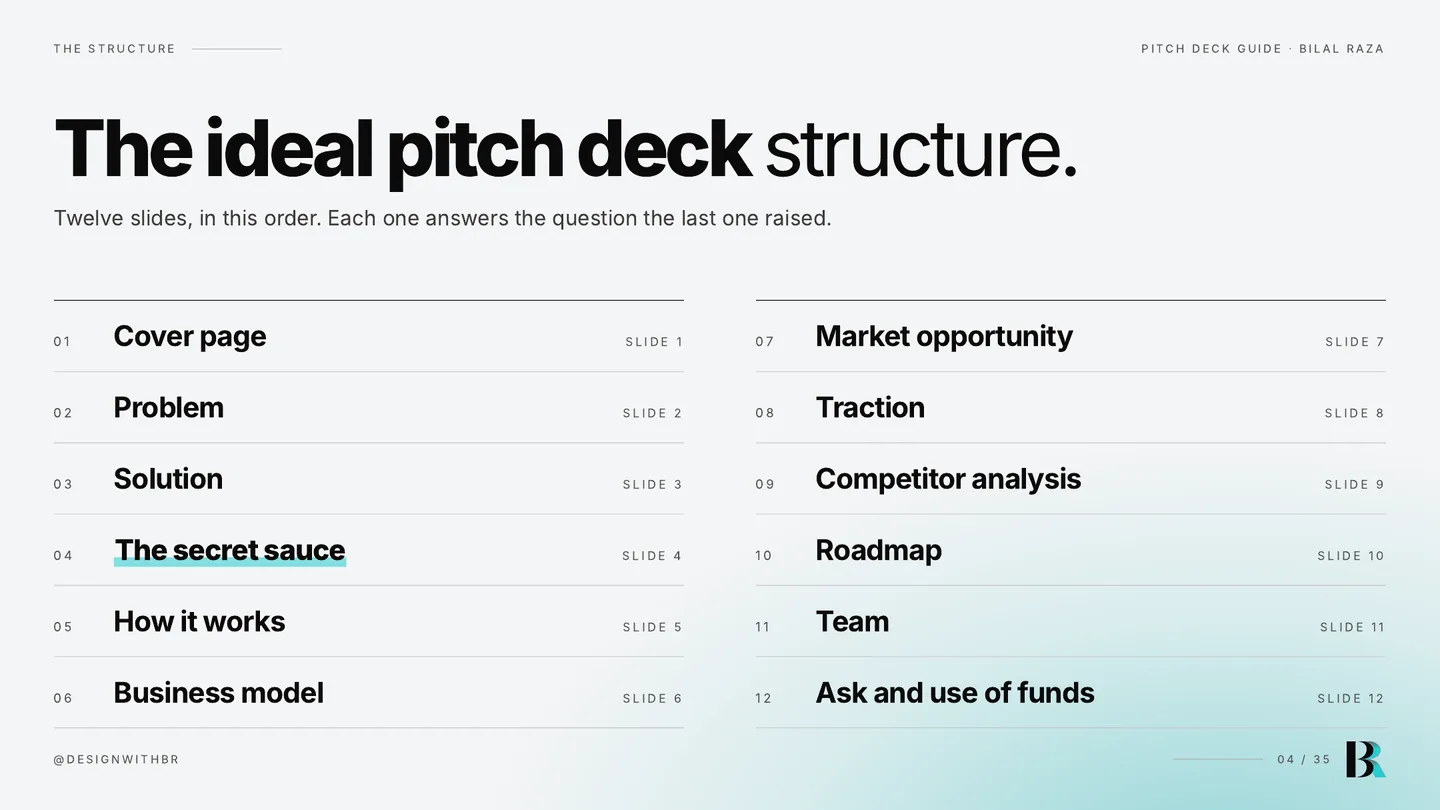
What slides should a pitch deck have?

Twelve, in this order: cover, problem, solution, your secret sauce, how it works, business model, market opportunity, traction, competitors, product roadmap, team, and the ask with use of funds. This guide shows what each slide needs, with examples from decks that raised funding.
Slide 4 of 35Slide 04 of 35
Before you start

Why a deck matters.

  1. 01.Effective communication. Startups can clearly and concisely share their vision, value proposition, business model and strategy. It tells the company story and sparks interest.
  2. 02.Trust building. A deck shows you understand the market and your customers, and can handle challenges. Data, wins and progress build trust in what you are building.
  3. 03.Investment attraction. Decks are how you persuade investors the opportunity is worth backing. A well structured deck helps secure the funding you need to grow.
  4. 04.Strategic orientation. Building a deck forces clear thinking. It sharpens your vision, your priorities, your unique value and your market strategy.
Slide 6 of 35Slide 06 of 35
01.Slide 01 · Cover

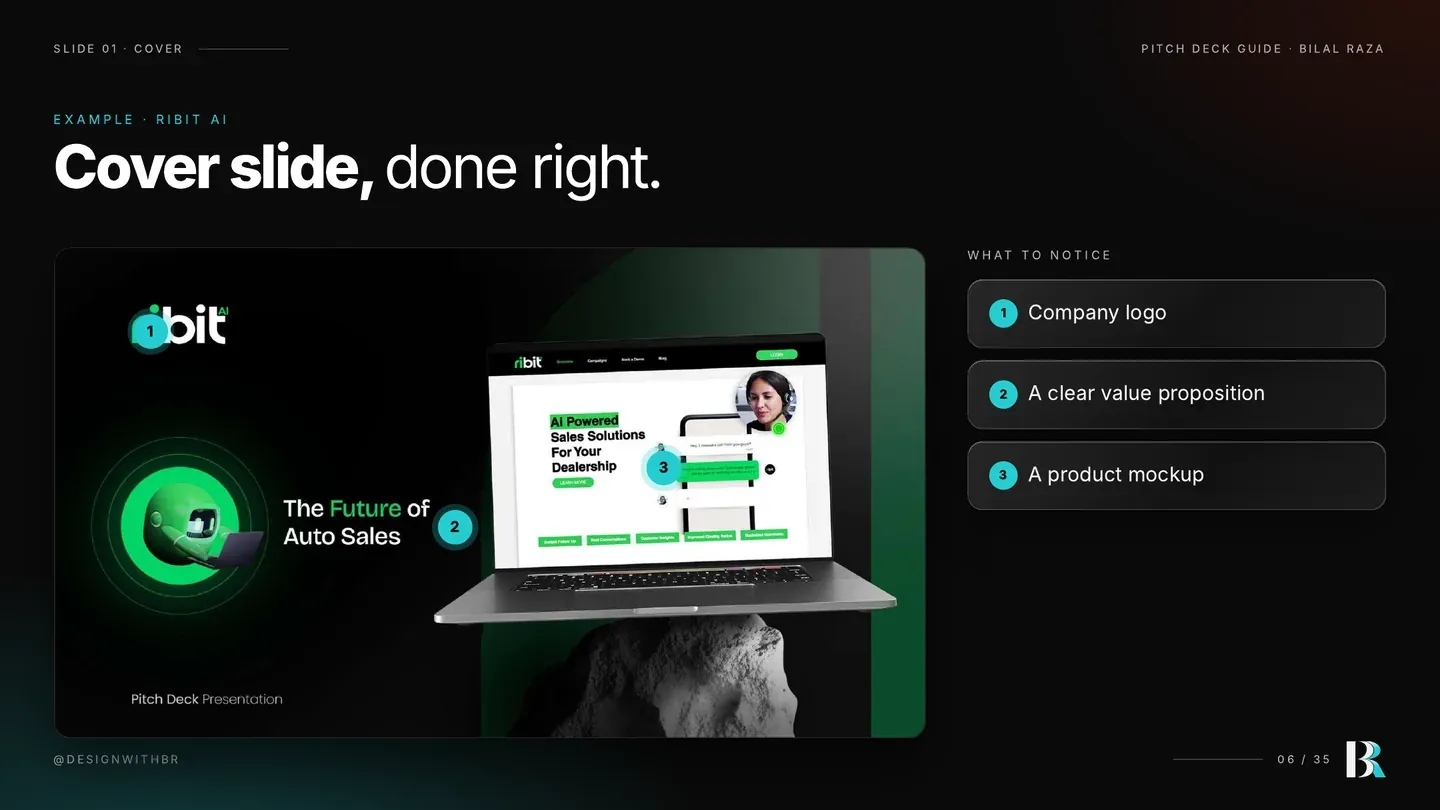
Cover page. Your first impression starts here.

Think of it as your opening handshake. It should be clean, confident and unmistakably you.

  1. 01.This slide sets the tone for everything that follows, so keep it sharp.
  2. 02.Include your startup's name, logo and a short slogan that captures your vision.
  3. 03.Add a polished product mockup or branded visual to hint at what's coming.
What to notice · Ribit AI example
  1. 1Company logo
  2. 2A clear value proposition
  3. 3A product mockup
Slide 8 of 35Slide 08 of 35
02.Slide 02 · Problem

Problem slide. Before you talk about your startup.

Your first job? Make the problem feel huge.

  1. 01.It should hit the investor right away: “Whoa, this is serious.”
  2. 02.If the problem doesn't feel big, the solution won't feel needed.
  3. 03.Use real numbers, real pain and real urgency.
  4. 04.Make them care before you show how you fix it.
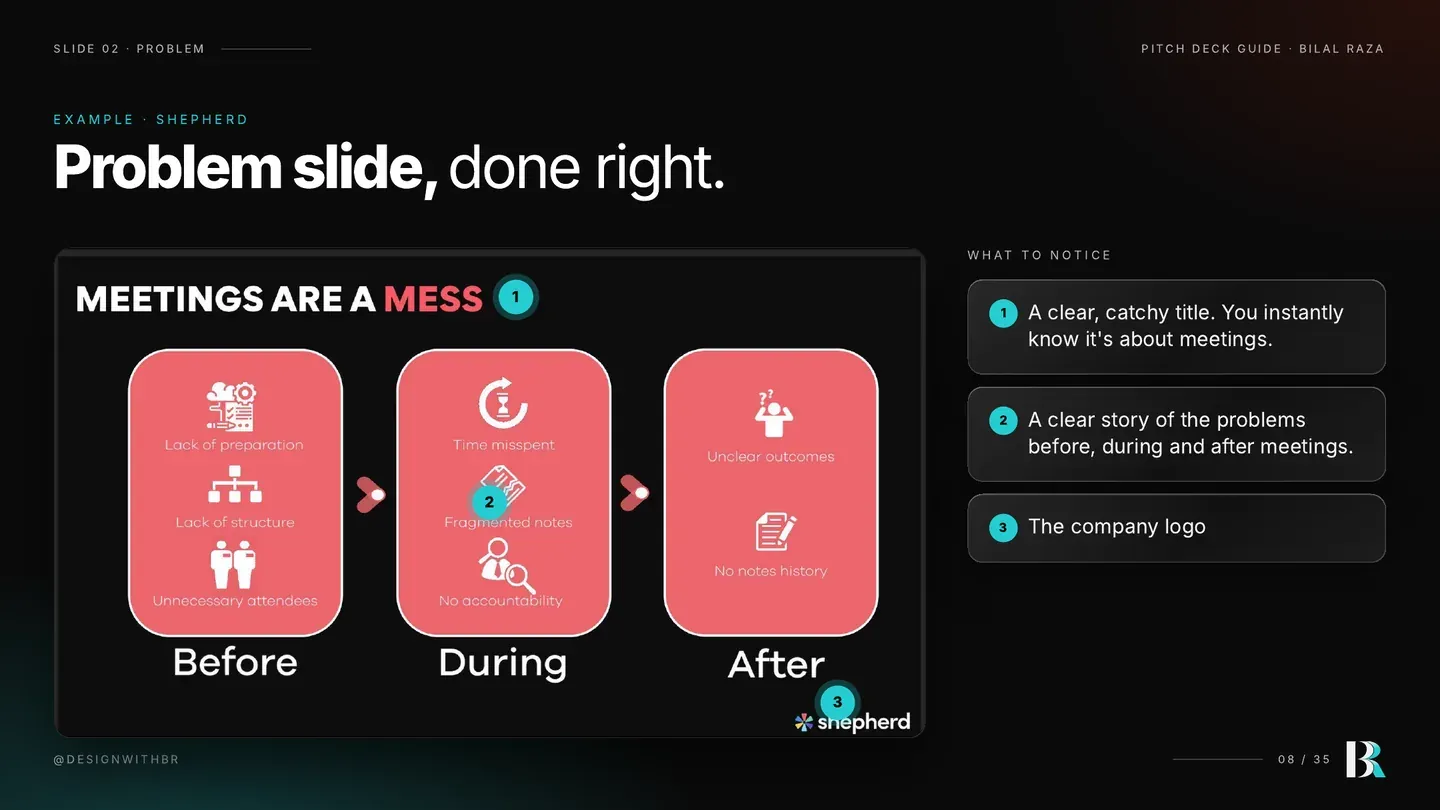
What to notice · Shepherd example
  1. 1A clear, catchy title. You instantly know it's about meetings.
  2. 2A clear story of the problems before, during and after meetings.
  3. 3The company logo
Slide 10 of 35Slide 10 of 35
03.Slide 03 · Solution

Make the solution crystal clear.

They know the problem. Now show them how you solve it. And most importantly, why your solution.

  1. 01.Focus on the outcome, not the tech.
  2. 02.Keep it visual.
  3. 03.Make it feel like the obvious fix.
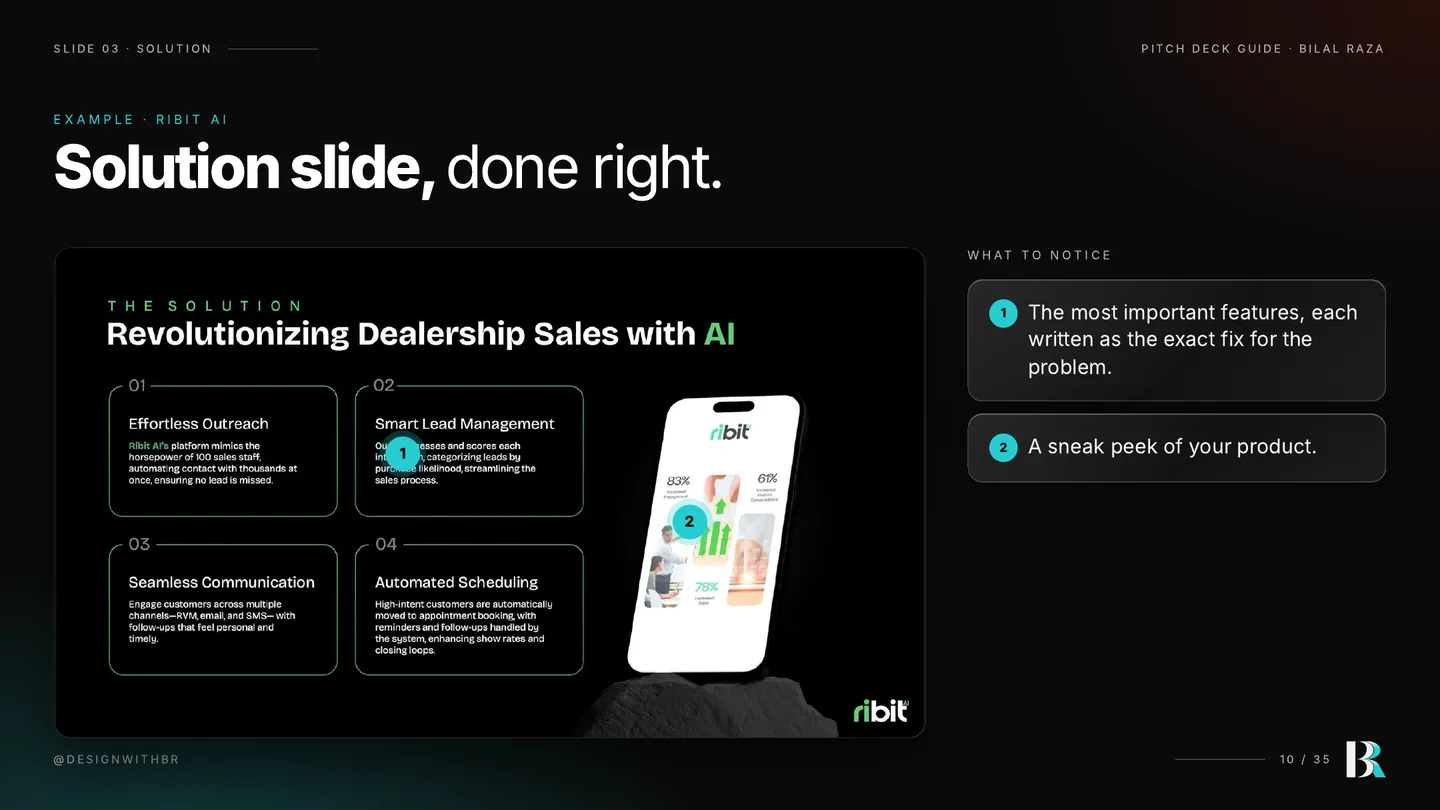
What to notice · Ribit AI example
  1. 1The most important features, each written as the exact fix for the problem.
  2. 2A sneak peek of your product.
Slide 12 of 35Slide 12 of 35
04.Slide 04 · Secret sauce

The secret sauce. Most decks just explain the solution.

Winning decks compare it, and then they win.

  1. 01.Show how others are doing it, and why it's broken.
  2. 02.Now drop your solution right next to it.
  3. 03.Don't just say you're better. Prove it with visuals.
  4. 04.And that is your secret sauce.
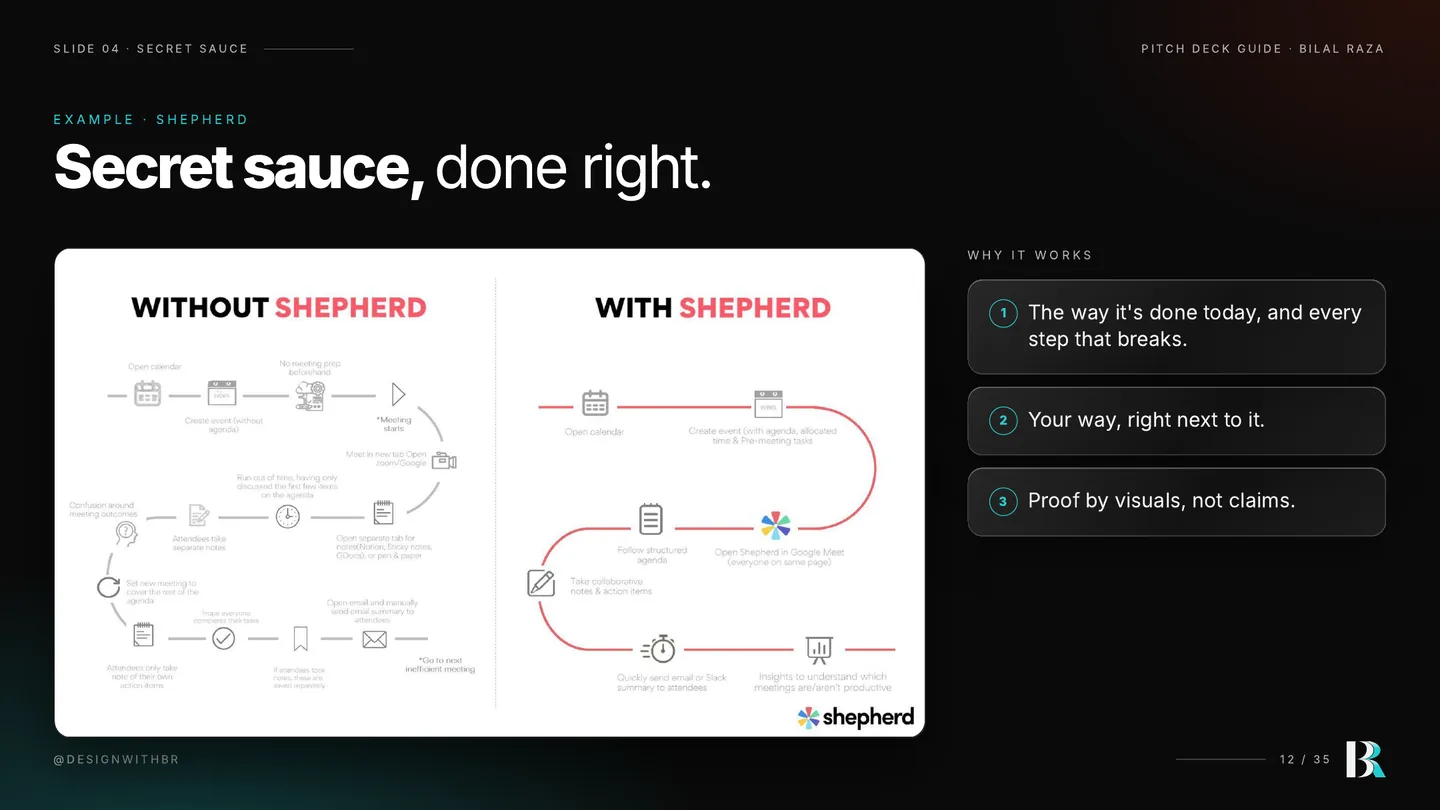
Why it works · Shepherd example
  1. 1The way it's done today, and every step that breaks.
  2. 2Your way, right next to it.
  3. 3Proof by visuals, not claims.
Slide 14 of 35Slide 14 of 35
05.Slide 05 · How it works

How it works. Investors don't need every detail.

They just want to know it's real and doable.

  1. 01.Break it down into 3 to 4 simple steps.
  2. 02.Keep it visual. Think flow, not paragraphs.
  3. 03.Show the journey from problem to solution.
  4. 04.Make it feel smooth, scalable and already working.
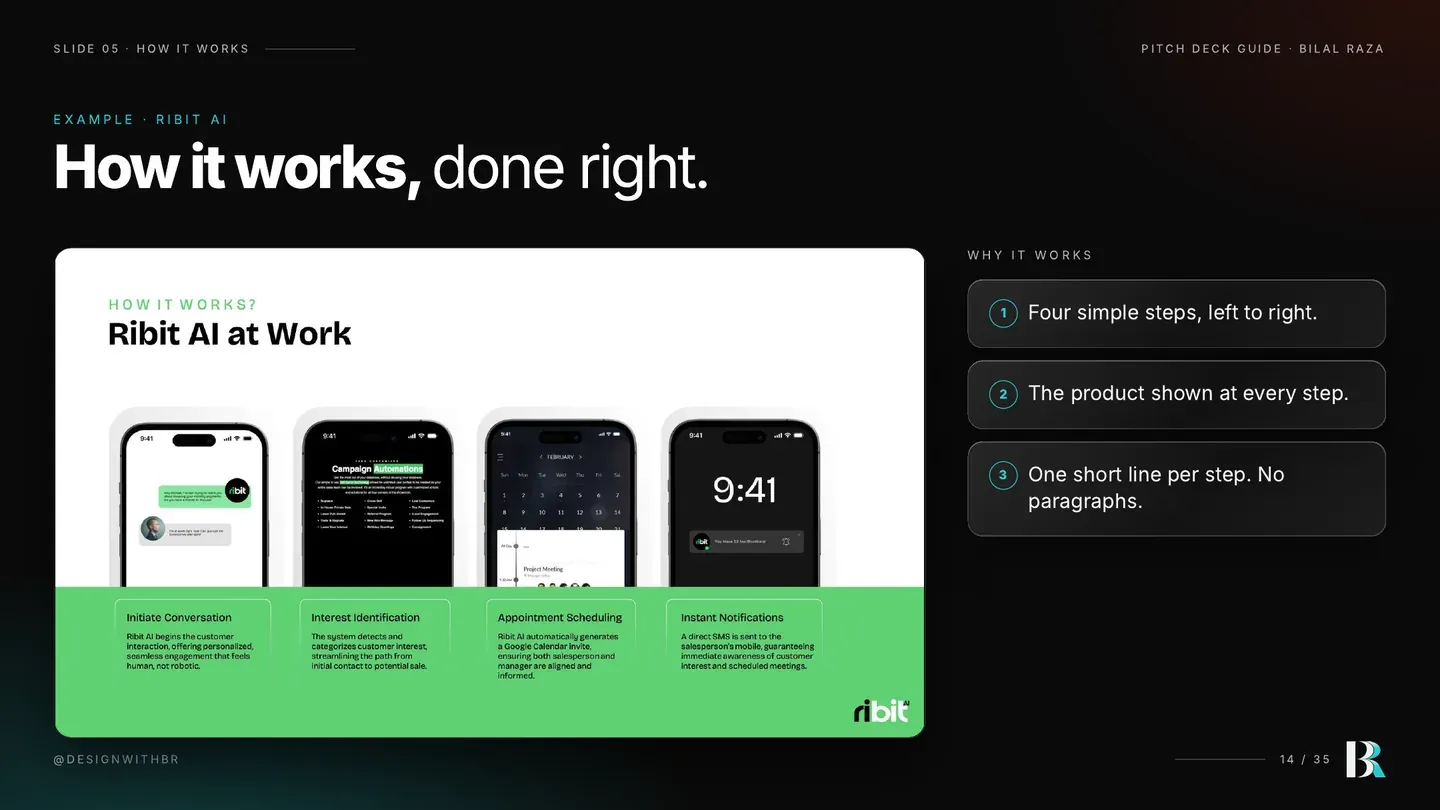
Why it works · Ribit AI example
  1. 1Four simple steps, left to right.
  2. 2The product shown at every step.
  3. 3One short line per step. No paragraphs.
Slide 16 of 35Slide 16 of 35
06.Slide 06 · Business model

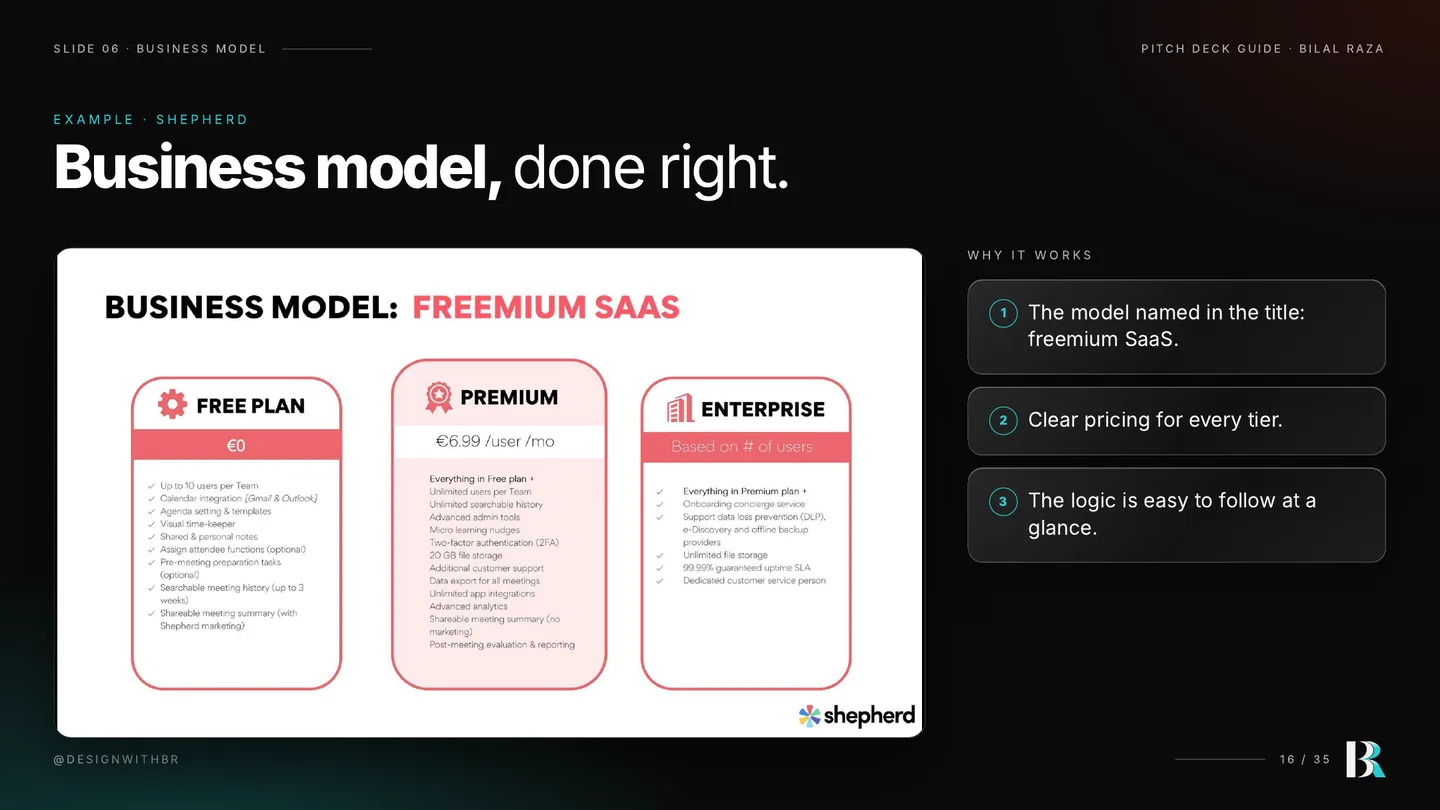
Business model. Show how the money flows.

This slide can be a deal breaker or a deal maker.

  1. 01.Make sure your business model makes sense.
  2. 02.Keep it simple: your pricing model, your revenue streams and the logic behind them.
  3. 03.Let investors see a business, not just a product.
Why it works · Shepherd example
  1. 1The model named in the title: freemium SaaS.
  2. 2Clear pricing for every tier.
  3. 3The logic is easy to follow at a glance.
Slide 18 of 35Slide 18 of 35
07.Slide 07 · Market

Market opportunity.

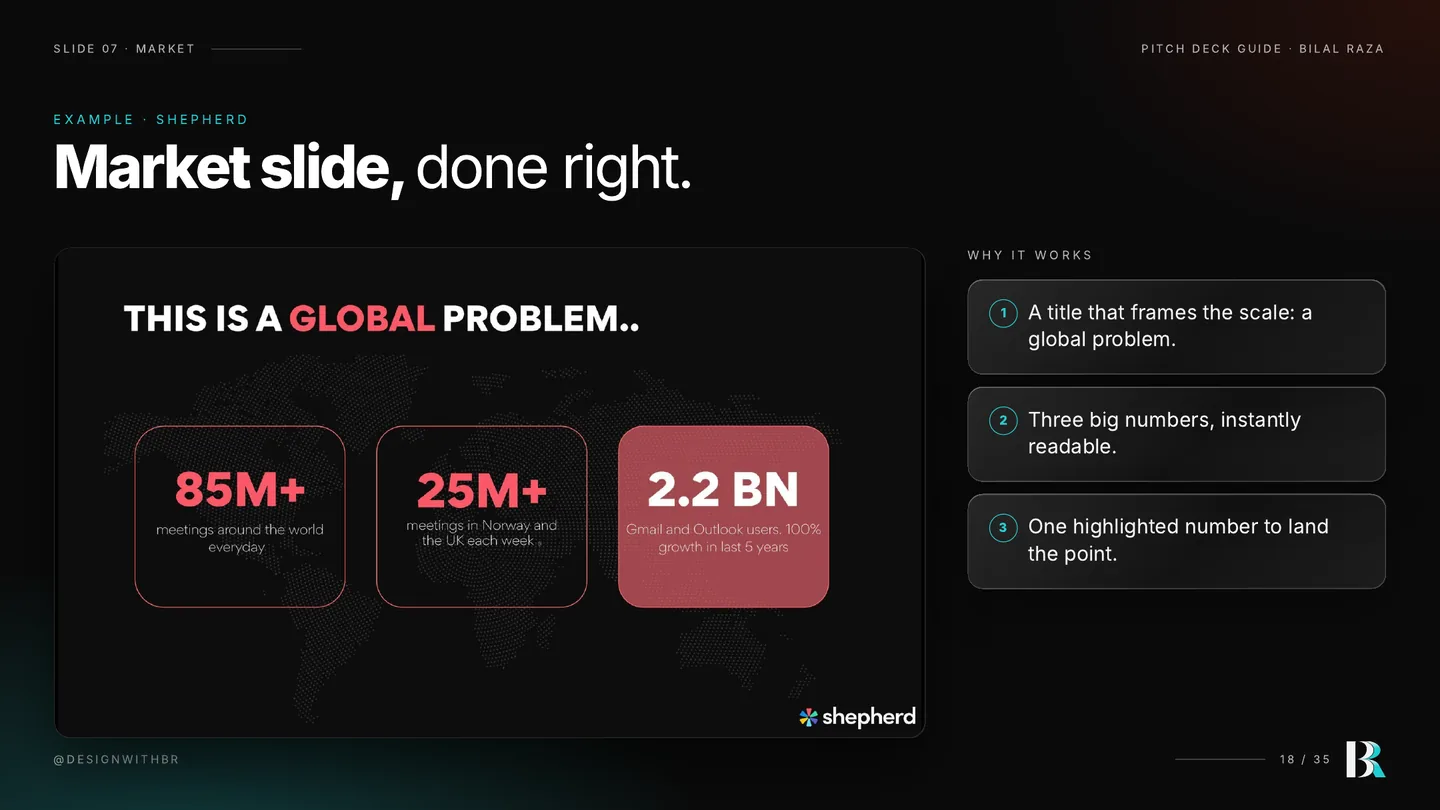
Show the scale of the problem you're solving. You're answering one big question: how big can this get?

  1. 01.Break down TAM, SAM and SOM.
  2. 02.Use clear numbers.
  3. 03.Back every number with a source.
Why it works · Shepherd example
  1. 1A title that frames the scale: a global problem.
  2. 2Three big numbers, instantly readable.
  3. 3One highlighted number to land the point.
Slide 20 of 35Slide 20 of 35
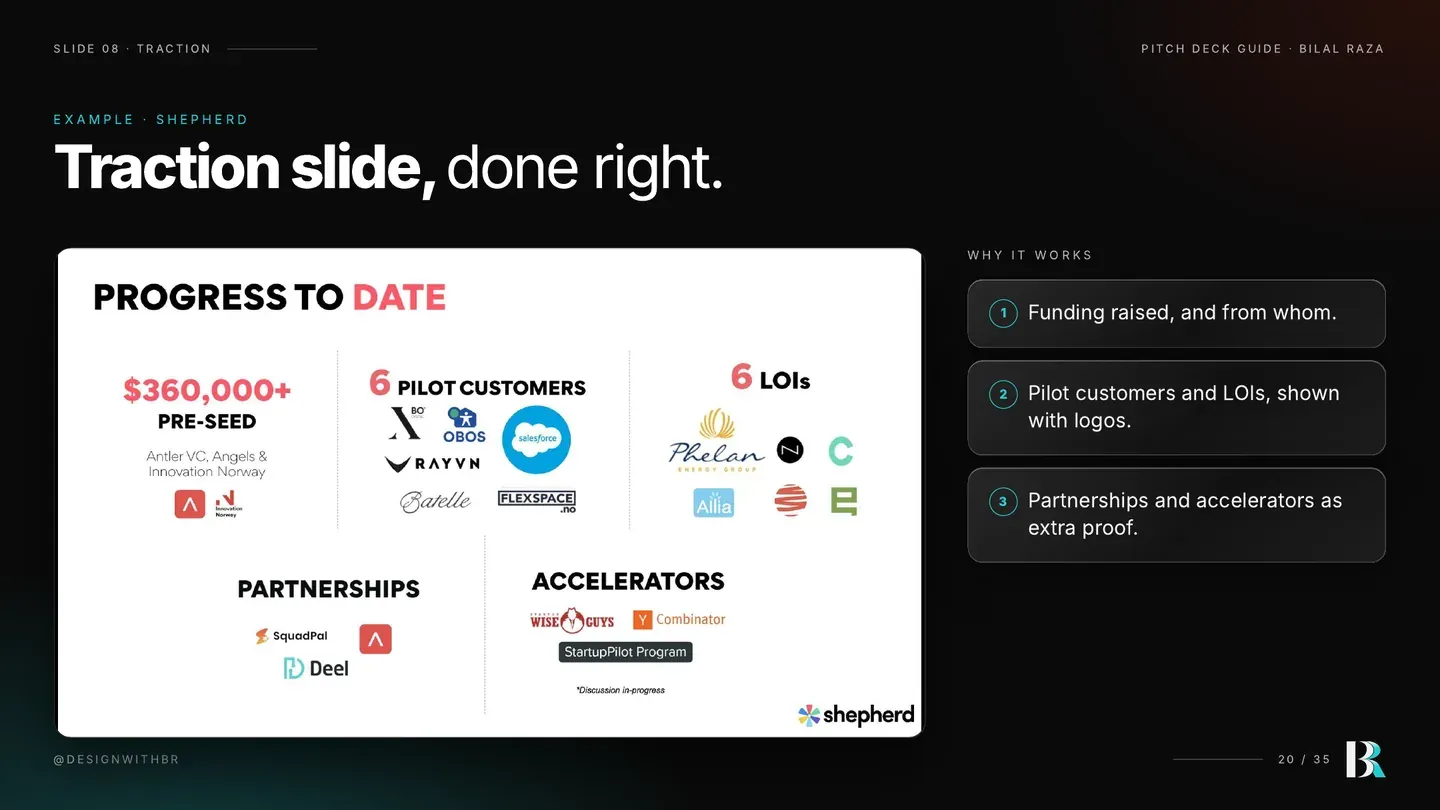
08.Slide 08 · Traction

Traction. This is where momentum lives.

Show what you've done. Share your most meaningful metrics.

  1. 01.Revenue
  2. 02.Users
  3. 03.Retention
  4. 04.Partnerships
  5. 05.Waitlists
Why it works · Shepherd example
  1. 1Funding raised, and from whom.
  2. 2Pilot customers and LOIs, shown with logos.
  3. 3Partnerships and accelerators as extra proof.
Slide 22 of 35Slide 22 of 35
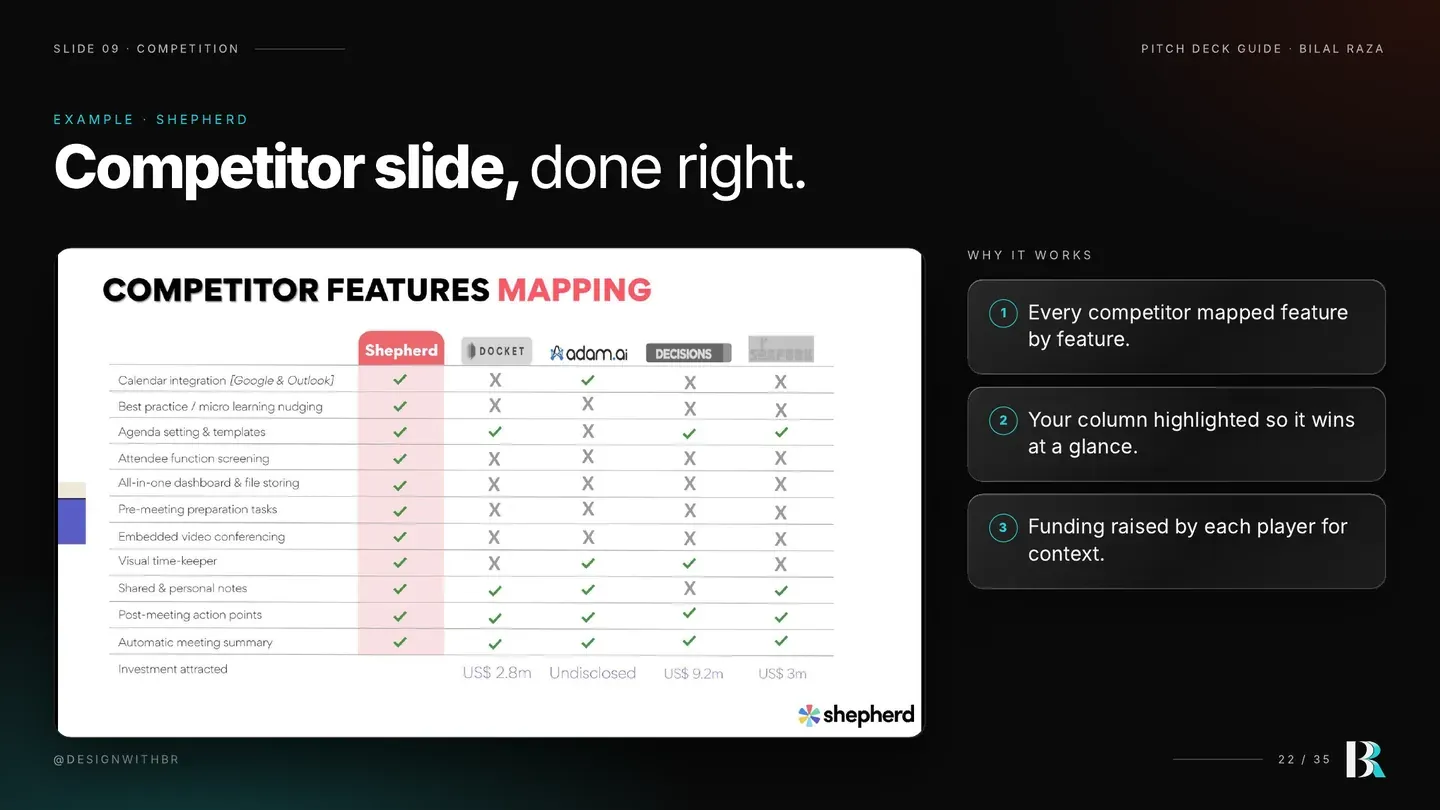
09.Slide 09 · Competition

Competitor analysis.

You're not alone, and that's a good thing. Show who's in the space, what they're missing and where you win.

  1. 01.Map the landscape.
  2. 02.Show every serious player side by side.
  3. 03.Position yourself clearly.
Why it works · Shepherd example
  1. 1Every competitor mapped feature by feature.
  2. 2Your column highlighted so it wins at a glance.
  3. 3Funding raised by each player for context.
Slide 24 of 35Slide 24 of 35
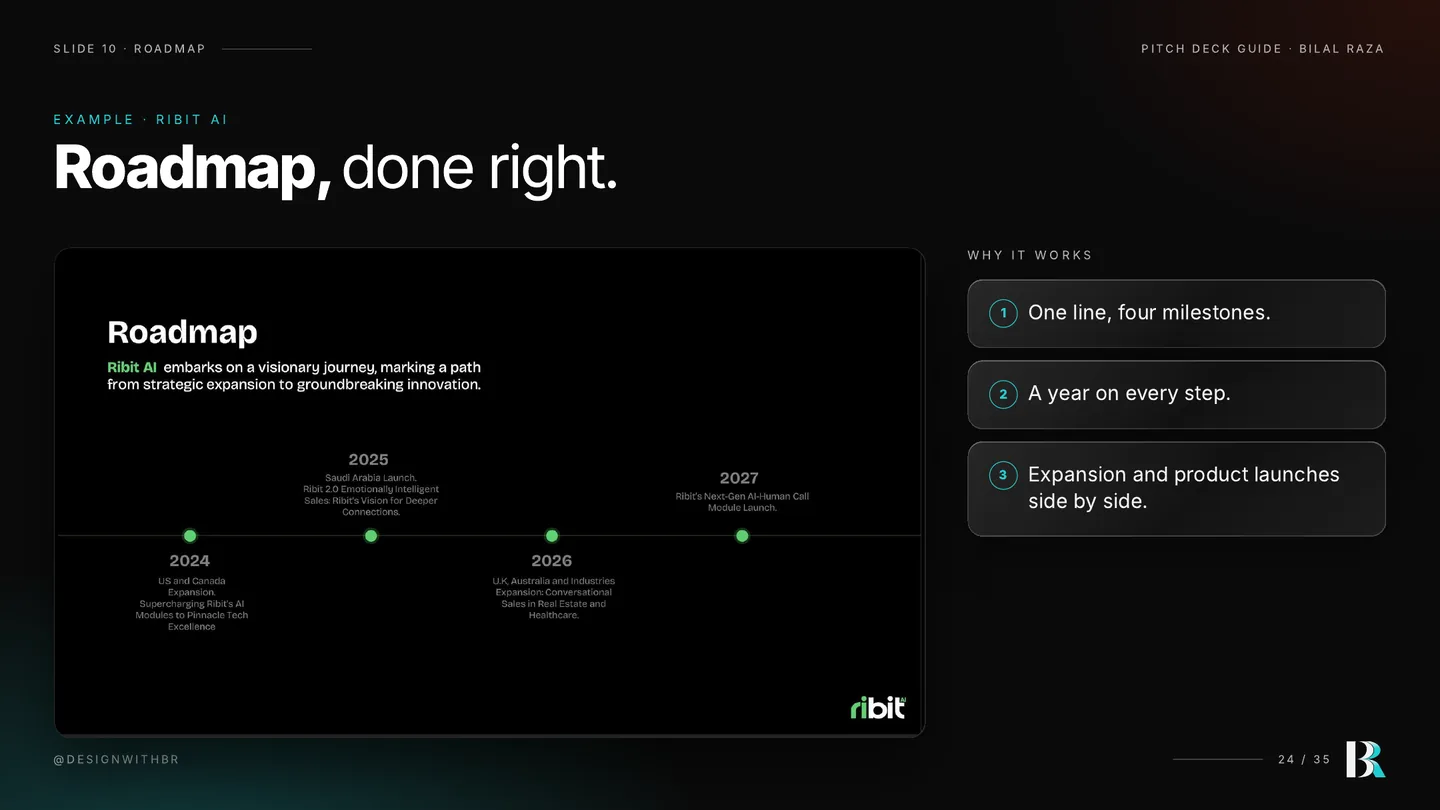
10.Slide 10 · Roadmap

Product roadmap. What's coming next, and why it matters.

Lay out your upcoming milestones across product, team and market.

  1. 01.Treat this slide as your vision, laid out clearly for investors.
  2. 02.Keep it high level but clear.
  3. 03.Show this isn't a one feature wonder. It's a company with direction.
Why it works · Ribit AI example
  1. 1One line, four milestones.
  2. 2A year on every step.
  3. 3Expansion and product launches side by side.
Slide 26 of 35Slide 26 of 35
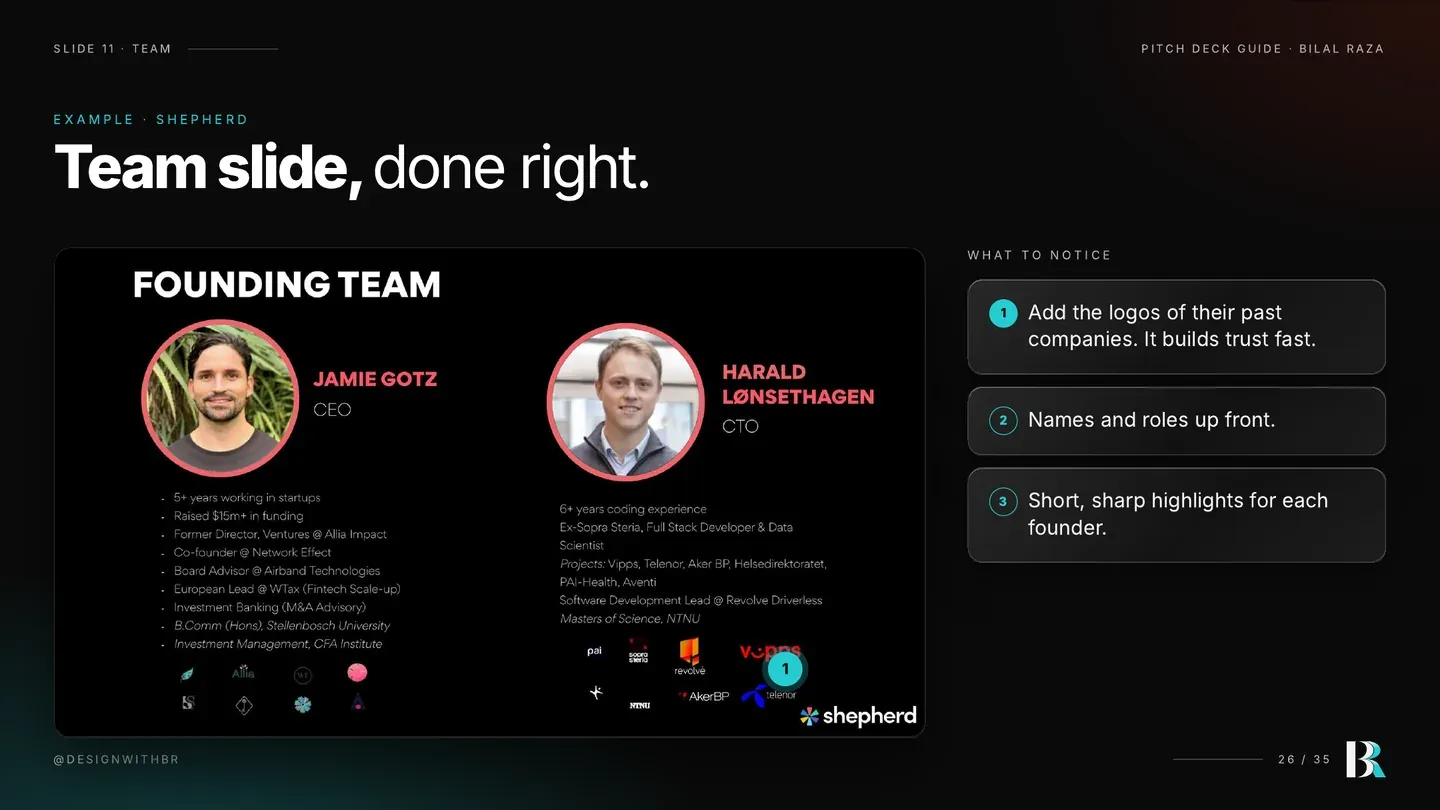
11.Slide 11 · Team

Team slide. People build companies.

Investors bet on people.

  1. 01.Introduce the team behind the mission.
  2. 02.Highlight backgrounds, strengths and the experience that makes you the right group to take this forward.
  3. 03.Keep it sharp, not resume heavy.
What to notice · Shepherd example
  1. 1Add the logos of their past companies. It builds trust fast.
  2. 2Names and roles up front.
  3. 3Short, sharp highlights for each founder.
Slide 28 of 35Slide 28 of 35
12.Slide 12 · Ask

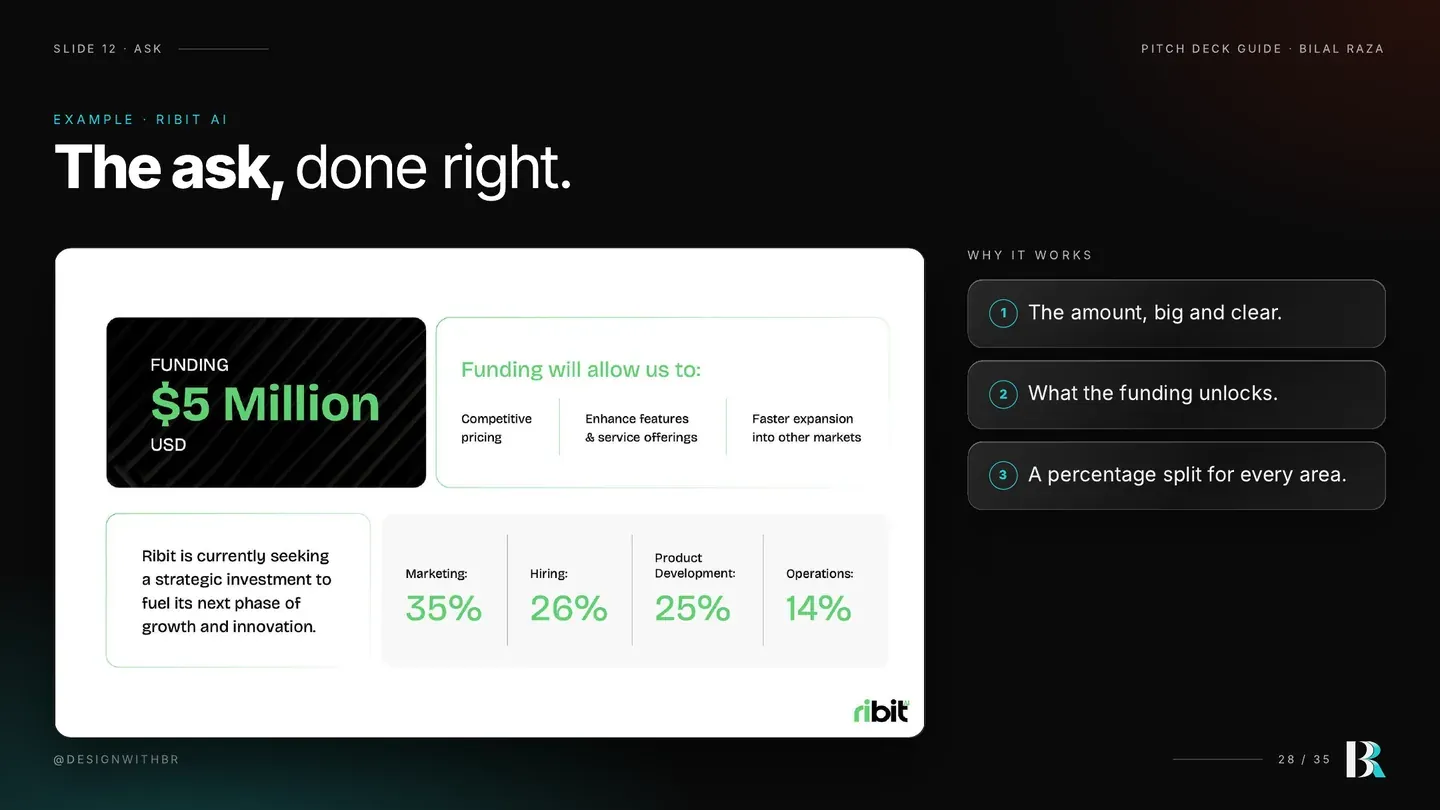
Ask and use of funds.

Here's what we need, and where it's going. State how much you're raising and exactly where it goes.

  1. 01.Break down the allocation clearly: product, hiring, growth and more.
  2. 02.Make the ask relevant to your stage.
  3. 03.Know exactly where you would spend every dollar.
Why it works · Ribit AI example
  1. 1The amount, big and clear.
  2. 2What the funding unlocks.
  3. 3A percentage split for every area.
Downloads

Take it with you.

The files for this guide. Free.

PDFThe Pitch Deck Design GuidePDF · 35 pages · 9.6 MB · by Bilal RazaDownload

More free guides

Newest first
Motion

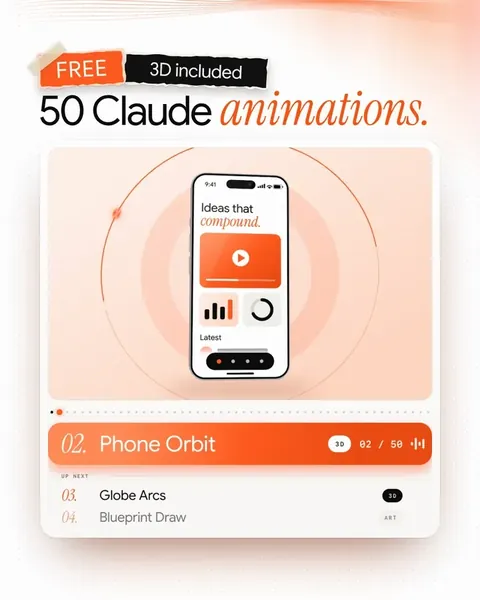
50 Claude animations. Free (3D included)

One prompt for each. 20 are in 3D.Open the guide
1/50
Video & reels

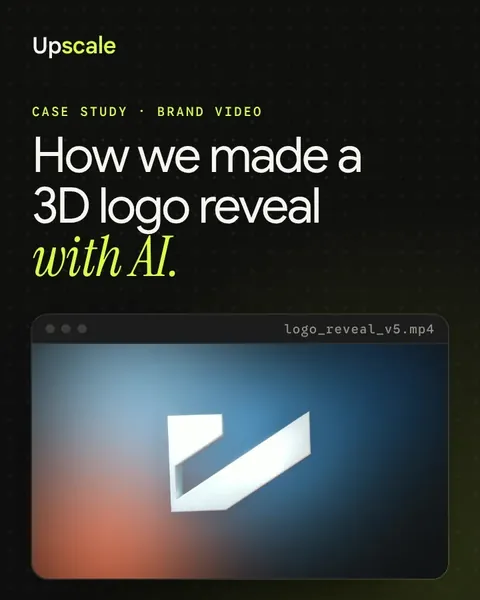
How we made a 3D logo reveal with AI.

A real brand video. 10 steps and 10 prompts.Open the guide
1/10
Apps & UI

Design a full app in Claude, the easy way.

5 steps, 5 prompts and one checklist.Open the guide

1/9

UpscaleTry free7 days
Try Upscale free 7 days · Start now75K+ on InstagramEvery prompt free to copyTry Upscale free 7 days · Start now

The pitch deck design guide.

A practical guide with real examples from pitch decks that actually raised funding. Twelve slides, in order: what each one needs, and an example done right.

BilalPosted byBilal @designwithbrPitch decks
In short

What slides should a pitch deck have?

Twelve, in this order: cover, problem, solution, your secret sauce, how it works, business model, market opportunity, traction, competitors, product roadmap, team, and the ask with use of funds. This guide shows what each slide needs, with examples from decks that raised funding.

Before you start

Why a deck matters.

  1. 01.Effective communication. Startups can clearly and concisely share their vision, value proposition, business model and strategy. It tells the company story and sparks interest.
  2. 02.Trust building. A deck shows you understand the market and your customers, and can handle challenges. Data, wins and progress build trust in what you are building.
  3. 03.Investment attraction. Decks are how you persuade investors the opportunity is worth backing. A well structured deck helps secure the funding you need to grow.
  4. 04.Strategic orientation. Building a deck forces clear thinking. It sharpens your vision, your priorities, your unique value and your market strategy.
Slide 6 of 3506/35
01.Slide 01 · Cover

Cover page. Your first impression starts here.

Think of it as your opening handshake. It should be clean, confident and unmistakably you.

  1. 01.This slide sets the tone for everything that follows, so keep it sharp.
  2. 02.Include your startup's name, logo and a short slogan that captures your vision.
  3. 03.Add a polished product mockup or branded visual to hint at what's coming.
What to notice · Ribit AI example
  1. 1Company logo
  2. 2A clear value proposition
  3. 3A product mockup
Slide 8 of 3508/35
02.Slide 02 · Problem

Problem slide. Before you talk about your startup.

Your first job? Make the problem feel huge.

  1. 01.It should hit the investor right away: “Whoa, this is serious.”
  2. 02.If the problem doesn't feel big, the solution won't feel needed.
  3. 03.Use real numbers, real pain and real urgency.
  4. 04.Make them care before you show how you fix it.
What to notice · Shepherd example
  1. 1A clear, catchy title. You instantly know it's about meetings.
  2. 2A clear story of the problems before, during and after meetings.
  3. 3The company logo
Slide 10 of 3510/35
03.Slide 03 · Solution

Make the solution crystal clear.

They know the problem. Now show them how you solve it. And most importantly, why your solution.

  1. 01.Focus on the outcome, not the tech.
  2. 02.Keep it visual.
  3. 03.Make it feel like the obvious fix.
What to notice · Ribit AI example
  1. 1The most important features, each written as the exact fix for the problem.
  2. 2A sneak peek of your product.
Slide 12 of 3512/35
04.Slide 04 · Secret sauce

The secret sauce. Most decks just explain the solution.

Winning decks compare it, and then they win.

  1. 01.Show how others are doing it, and why it's broken.
  2. 02.Now drop your solution right next to it.
  3. 03.Don't just say you're better. Prove it with visuals.
  4. 04.And that is your secret sauce.
Why it works · Shepherd example
  1. 1The way it's done today, and every step that breaks.
  2. 2Your way, right next to it.
  3. 3Proof by visuals, not claims.
Slide 14 of 3514/35
05.Slide 05 · How it works

How it works. Investors don't need every detail.

They just want to know it's real and doable.

  1. 01.Break it down into 3 to 4 simple steps.
  2. 02.Keep it visual. Think flow, not paragraphs.
  3. 03.Show the journey from problem to solution.
  4. 04.Make it feel smooth, scalable and already working.
Why it works · Ribit AI example
  1. 1Four simple steps, left to right.
  2. 2The product shown at every step.
  3. 3One short line per step. No paragraphs.
Slide 16 of 3516/35
06.Slide 06 · Business model

Business model. Show how the money flows.

This slide can be a deal breaker or a deal maker.

  1. 01.Make sure your business model makes sense.
  2. 02.Keep it simple: your pricing model, your revenue streams and the logic behind them.
  3. 03.Let investors see a business, not just a product.
Why it works · Shepherd example
  1. 1The model named in the title: freemium SaaS.
  2. 2Clear pricing for every tier.
  3. 3The logic is easy to follow at a glance.
Slide 18 of 3518/35
07.Slide 07 · Market

Market opportunity.

Show the scale of the problem you're solving. You're answering one big question: how big can this get?

  1. 01.Break down TAM, SAM and SOM.
  2. 02.Use clear numbers.
  3. 03.Back every number with a source.
Why it works · Shepherd example
  1. 1A title that frames the scale: a global problem.
  2. 2Three big numbers, instantly readable.
  3. 3One highlighted number to land the point.
Slide 20 of 3520/35
08.Slide 08 · Traction

Traction. This is where momentum lives.

Show what you've done. Share your most meaningful metrics.

  1. 01.Revenue
  2. 02.Users
  3. 03.Retention
  4. 04.Partnerships
  5. 05.Waitlists
Why it works · Shepherd example
  1. 1Funding raised, and from whom.
  2. 2Pilot customers and LOIs, shown with logos.
  3. 3Partnerships and accelerators as extra proof.
Slide 22 of 3522/35
09.Slide 09 · Competition

Competitor analysis.

You're not alone, and that's a good thing. Show who's in the space, what they're missing and where you win.

  1. 01.Map the landscape.
  2. 02.Show every serious player side by side.
  3. 03.Position yourself clearly.
Why it works · Shepherd example
  1. 1Every competitor mapped feature by feature.
  2. 2Your column highlighted so it wins at a glance.
  3. 3Funding raised by each player for context.
Slide 24 of 3524/35
10.Slide 10 · Roadmap

Product roadmap. What's coming next, and why it matters.

Lay out your upcoming milestones across product, team and market.

  1. 01.Treat this slide as your vision, laid out clearly for investors.
  2. 02.Keep it high level but clear.
  3. 03.Show this isn't a one feature wonder. It's a company with direction.
Why it works · Ribit AI example
  1. 1One line, four milestones.
  2. 2A year on every step.
  3. 3Expansion and product launches side by side.
Slide 26 of 3526/35
11.Slide 11 · Team

Team slide. People build companies.

Investors bet on people.

  1. 01.Introduce the team behind the mission.
  2. 02.Highlight backgrounds, strengths and the experience that makes you the right group to take this forward.
  3. 03.Keep it sharp, not resume heavy.
What to notice · Shepherd example
  1. 1Add the logos of their past companies. It builds trust fast.
  2. 2Names and roles up front.
  3. 3Short, sharp highlights for each founder.
Slide 28 of 3528/35
12.Slide 12 · Ask

Ask and use of funds.

Here's what we need, and where it's going. State how much you're raising and exactly where it goes.

  1. 01.Break down the allocation clearly: product, hiring, growth and more.
  2. 02.Make the ask relevant to your stage.
  3. 03.Know exactly where you would spend every dollar.
Why it works · Ribit AI example
  1. 1The amount, big and clear.
  2. 2What the funding unlocks.
  3. 3A percentage split for every area.
Downloads

Take it with you.

The files for this guide. Free.

PDFThe Pitch Deck Design GuidePDF · 35 pages · 9.6 MB · by Bilal RazaDownload
Zee and Bilal, hosts of Upscale
UpscaleAI Creative Club on Skool
Hosted by Zee and Bilal

Learn AI with us, every day.

  • Daily video tutorials
  • New AI tools tested every week
  • A room of creatives sharing wins, work and new finds
Try Upscale free7 days

More free guides

1/50Motion

50 Claude animations. Free (3D included)

One prompt for each. 20 are in 3D.
1/10Video & reels

How we made a 3D logo reveal with AI.

A real brand video. 10 steps and 10 prompts.
1/9Apps & UI

Design a full app in Claude, the easy way.

5 steps, 5 prompts and one checklist.